Founded in 1990, Sharpe Products is an ISO 9001:2015 certified company specializing in industrial and commercial pipe and tube bending, laser cutting, end-forming or other custom fabrication services. In addition, we offer a robust line of architectural handrail fittings and accessories such as brackets, connectors, disks, end-caps, flanges, newel caps and spheres.

Here at Zeman Manufacturing Company we offer a number of services and products including: tube bending, tube end forming, tube assembly, tube cutting, hypodermic tube fabrication, tube coiling, tube swaging, lubricating oil cups, metal tube spacers and custom miniature headers. If you have any specialized requests then give one of our representatives a call today! Please visit our website if you...

With 75+ years of experience, H-P Products, Inc. is a leader in precision tube fabrication. We offer CNC bending up to 8" OD, NC bending up to 10" OD, laser tube cutting, welding, and end-forming to support a wide range of industries. From complex geometries to contract manufacturing, customers rely on us for consistent quality and dependable results.
Diemo Machine Works provides precision machining, custom fabrication, welding, laser cutting, and tube bending services. With meticulous attention to detail and commitment to excellence, we deliver high-quality, custom-engineered solutions that meet the diverse needs of our clients across various industries.

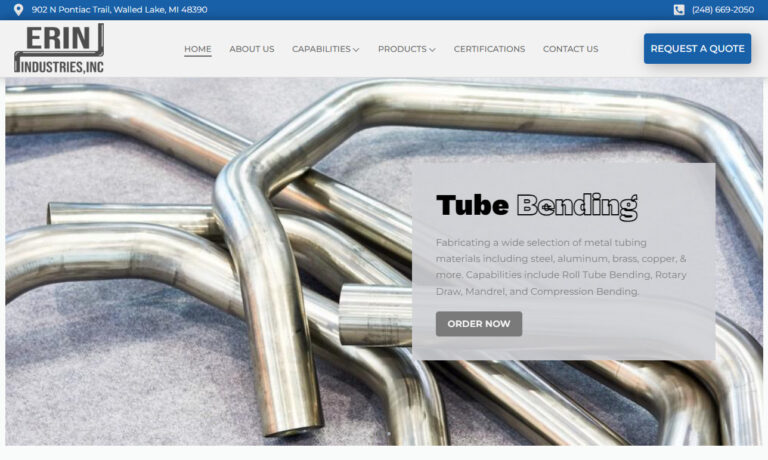
At Erin Industries, Inc., we take great pride in our expertise and capabilities in the field of tube fabrication. With a commitment to precision, reliability, and innovation, we continuously strive to elevate the standards of tube fabrication within the industry. Erin Industries, Inc. is your trusted partner for all your tube fabrication needs, delivering products and services that meet and...
Great Lakes Powder Coating, L.L.C. (GLPC) is a leading provider of comprehensive manufacturing solutions, specializing in CAD design, tube bending, laser cutting, media blasting, welding, powder coating, and pre-treatment services. With a commitment to precision and quality, GLPC excels in delivering custom, high-performance finishes that meet the exacting standards of various industries,...

At Fraser Steel Company, we take pride in delivering precision tube fabrication solutions that meet the highest standards of quality and reliability. We specialize in producing custom metal tubing for a wide range of industries, leveraging our expertise in bending, cutting, and forming to create components that perform under the most demanding conditions.

At TubeCo, Inc., we take pride in our ability to provide comprehensive tube fabrication solutions that meet a diverse range of industry needs. With decades of experience, we excel in crafting high-quality tubes tailored to our clients' precise specifications. Our extensive portfolio includes everything from standard and custom tube designs to complex, precision-engineered components. Our...




More Tube Swaging Manufacturers
Tube swaging is a highly precise and reliable tube fabrication process that plays a critical role in modern manufacturing and industrial applications. Unlike tube forging, which uses intense heat to mold and shape tubing, tube swaging is a cold working process performed under high pressure. This method involves the mechanical or hydraulic deformation of tubing or piping, allowing manufacturers to connect tubes, reduce or expand diameters, and achieve complex geometries without compromising the material's integrity. Swaging produces a permanent, leak-proof joint between previously unattached components, making it an essential solution for industries that demand precision and durability in their tube assemblies.
 Tube Swaging Services - Woolf Aircraft Products, Inc.
What Is Tube Swaging and How Does It Work?
Tube swaging is a form of metal tube forming that utilizes high-pressure force to reshape and join pipes or tubes without the use of heat. The process typically involves a swaging machine—either mechanical or hydraulic—equipped with specialized dies that compress an area of the tube. The pressure exerted by the dies reduces the tube’s diameter or alters its cross-sectional shape, enabling seamless connections to fittings, other tubes, or components. This results in a strong, durable connection—crucial for any application where leak-tight performance and structural integrity are paramount.
Key Methods in Tube Swaging
- Rotary swaging: Utilizes rapidly rotating dies to hammer and shape the tube uniformly, ideal for reducing diameter or forming complex profiles.
- Radial hammering: Involves repeated lateral pressure to compress the tube, commonly used for diameter reduction or prepping ends for attachment.
- Internal swaging: Expands the inside diameter rather than reducing the outer diameter, perfect for applications requiring tube expansion or connectivity to larger fittings.
Why Choose Swaging Over Other Tube Joining Methods?
Compared to welding, soldering, or brazing, swaging offers several advantages:
- Preserves the original material without heat-affected zones or material loss.
- Produces uniform, repeatable results with exceptional mechanical strength.
- Minimizes the risk of leaks in fluid transfer systems and hydraulic assemblies.
- Reduces the need for secondary finishing or additional sealing methods.
- Ideal for complex assemblies and high-volume production environments.
Applications of Tube Swaging Across Industries
Tube swaging is widely used in a variety of sectors that require robust and precise tube connections:
- Aerospace and Defense: For manufacturing high-pressure fuel lines, hydraulic systems, and structural components that demand lightweight strength and leak-proof performance.
- Automotive: In brake lines, exhaust systems, and fuel delivery assemblies where reliability and precision are non-negotiable.
- Medical Device Manufacturing: For making surgical instruments, diagnostic equipment, and fluid delivery systems that require sterile, seamless joins.
- Commercial HVAC and Refrigeration: Creating sealed refrigerant lines and heat exchanger tubes to prevent leakage and maintain system efficiency.
- Industrial Manufacturing: Building process piping, instrumentation, and automation systems that rely on high-integrity tube assemblies.
- Marine and Shipbuilding: Producing corrosion-resistant tube assemblies for fuel, water, and hydraulic transfer in harsh environments.
Common Materials Used in Tube Swaging
Swaging can be performed on a wide array of metal alloys and materials to suit different performance requirements and environments, including:
- Stainless steel: Corrosion-resistant and strong, ideal for hygiene-critical and high-pressure applications.
- Aluminum: Lightweight and malleable, perfect for aerospace and automotive uses.
- Steel: Durable and cost-effective for industrial and structural applications.
- Titanium: High strength-to-weight ratio and biocompatibility, essential for aerospace and medical industries.
- Copper and brass: Excellent for plumbing, HVAC, and instrumentation due to their thermal and electrical properties.
Curious about which tube material is right for your project? Explore our guide to tube end forming materials and applications.
Tube Swaging vs. Tube Flaring: What’s the Difference?
Both swaging and flaring are essential tube end forming processes, but they serve distinct purposes. Swaging compresses and reshapes the tube end to reduce or modify its diameter, creating a snug fit for joining with another tube or fitting. In contrast, tube flaring expands the end of the tube into a funnel or conical shape, allowing it to mate with a corresponding fitting, often using a flare nut to create a strong, sealed connection.
When should you use tube swaging vs. flaring?
- Choose swaging when you need to join tubes of different diameters or require a seamless, flush connection.
- Opt for flaring when working with high-pressure systems that demand a robust, leak-proof mechanical seal, such as in refrigeration or hydraulic lines.
Need help selecting the right end forming method for your application? Contact our tube fabrication specialists today.
Benefits of Tube Swaging for Industrial and Commercial Applications
Integrating tube swaging services into your manufacturing process offers numerous advantages:
- Leak-proof connections: Swaged joints are exceptionally tight, reducing the risk of leaks in critical fluid and gas transfer applications.
- Preservation of material strength: The cold-working process maintains the tube’s original mechanical properties, ensuring durability and longevity.
- Cost-effectiveness: Swaging eliminates the need for consumable materials such as welding rods or filler metals, reducing overall production costs.
- Precision and repeatability: Automated swaging machines deliver consistent, high-quality results for large production runs.
- Versatility: Suitable for a variety of tube diameters, wall thicknesses, and materials.
- Environmentally friendly: No emissions or hazardous byproducts are produced, supporting sustainable manufacturing practices.
Which industries benefit most from tube swaging?
Industries with demanding requirements for fluid dynamics, pressure containment, and structural integrity are the primary beneficiaries of tube swaging. If your business needs to create complex tube assemblies with reliable, leak-free connections, swaging is the preferred technique.
Tube Swaging Process: Step-by-Step Overview
Understanding the tube swaging process can help you evaluate whether it’s the right solution for your project. Here’s a typical workflow:
- Material selection: Choose the appropriate alloy and tube dimensions for your specific application.
- Preparation: Tubes are cut, cleaned, and deburred to ensure smooth, contaminant-free surfaces.
- Tooling setup: Select the correct swaging die and calibrate the swaging machine for the required dimensions and tolerances.
- Swaging operation: The tube is inserted into the die, and high-pressure force is applied, reshaping the tube end to the desired configuration.
- Quality inspection: Each swaged component is measured, tested, and inspected to ensure it meets all performance and dimensional standards.
- Assembly and finishing: Swaged tubes are joined to fittings or other tubes, and any necessary finishing steps (such as coating or marking) are performed.
Interested in seeing the tube swaging process in action?
Visit our tube fabrication gallery to explore photos and videos of swaging and other tube forming techniques.
Factors to Consider When Choosing Tube Swaging Services
Selecting the right tube swaging company is crucial for achieving optimal results. Here are some important decision factors to keep in mind:
- Expertise and experience: Look for providers with specialized knowledge in your industry and a proven track record with similar projects.
- Material capabilities: Ensure the company can handle your required alloys and tube sizes, including custom or exotic materials.
- Precision and tolerances: Verify that their equipment can achieve the tight tolerances and quality standards your application demands.
- Production capacity: Choose a partner with the resources to handle your project volume and lead times.
- Quality assurance: Ask about in-process inspection, non-destructive testing, and certifications such as ISO 9001 or AS9100.
- Customer support: Engaged and responsive customer service can accelerate prototyping, design changes, and order fulfillment.
Not sure what to look for in a tube swaging partner? Request a free consultation with our fabrication experts.
Tube Swaging Use Cases: Real-World Examples
Explore how leading manufacturers leverage tube swaging technology for superior product performance and reliability:
- Aircraft hydraulic assemblies: Swaged stainless steel tubes deliver unmatched pressure containment and vibration resistance for flight control systems.
- Medical device tubing: Precision swaging ensures sterile, leak-free connections in minimally invasive surgical instruments and diagnostic equipment.
- Automotive fuel and brake lines: Swaging creates strong, corrosion-resistant joints that meet strict safety standards.
- Industrial instrumentation: Swaged copper and brass tubes provide precise, durable connections for process control sensors and valves.
- HVAC and refrigeration: Swaged joints prevent refrigerant leaks and maintain system efficiency in chiller units and heat exchangers.
How can tube swaging improve your product’s performance?
Contact us to discuss your application requirements and discover how custom tube swaging solutions can enhance reliability, reduce costs, and streamline your manufacturing process.
Frequently Asked Questions About Tube Swaging
What is the difference between tube swaging and tube end forming?
Tube swaging is a specific technique under the broader category of tube end forming. While swaging involves compressing the tube end to change its diameter or profile, tube end forming includes a range of processes—such as flaring, beading, expanding, and reducing—each tailored to different connection or assembly requirements. Want to learn more? Read our detailed guide on tube end forming techniques.
Is tube swaging suitable for high-pressure systems?
Yes, tube swaging is frequently used in high-pressure and high-stress environments, such as hydraulic or fuel systems, because it produces strong, leak-resistant joints without weakening the parent material.
What tube diameters can be swaged?
Swaging can accommodate a wide range of tube sizes, from micro-diameter medical tubing to large industrial pipes. The specific size range depends on your application and the capabilities of your chosen fabricator.
Can swaging be used with both seamless and welded tubes?
Absolutely. Both seamless and welded tubes can undergo swaging, provided they meet the necessary material quality and dimensional tolerances for your application.
How do I request a quote for tube swaging services?
Ready to take the next step? Request a quote for custom tube swaging by providing your application details, material specifications, and desired quantities.
Get Started with Precision Tube Swaging Today
Choosing the right tube swaging services can make all the difference in your project’s success. Whether you’re in aerospace, medical, automotive, or industrial manufacturing, our expert team delivers precision, reliability, and value at every stage of production. Contact us today for a free consultation, and let’s build your next generation of high-performance tube assemblies together.
Looking for more information about tube fabrication, tube rolling, or end forming options? Visit our tube rolling resource page or browse our comprehensive tube fabrication services for more solutions.
 Broaching
 CNC Machining
 Expanded Metals
 Laser Cutting
 Metal Etching
 Metal Fabrication
 Perforated Metals
 Screw Machine Products
 Metal Stampings
 Sheet Metal Fabrication
 Tube Fabrication
 Water Jet Cutting
 Castings & Forgings
 Bulk Material Handling
 Electrical & Electronic Components
 Flow Instrumentation
 Hardware
 Material Handling Equipment
 Metal Cutting Services
 Metal Forming Services
 Metal Suppliers
 Motion Control Products
 Plant & Facility Equipment
 Plant & Facility Supplies
 Plastic Molding Processes
 Pumps & Valves
 Recycling Equipment
 Rubber Products & Services