Founded in 1990, Sharpe Products is an ISO 9001:2015 certified company specializing in industrial and commercial pipe and tube bending, laser cutting, end-forming or other custom fabrication services. In addition, we offer a robust line of architectural handrail fittings and accessories such as brackets, connectors, disks, end-caps, flanges, newel caps and spheres.
Here at Zeman Manufacturing Company we offer a number of services and products including: tube bending, tube end forming, tube assembly, tube cutting, hypodermic tube fabrication, tube coiling, tube swaging, lubricating oil cups, metal tube spacers and custom miniature headers. If you have any specialized requests then give one of our representatives a call today! Please visit our website if you...
With 75+ years of experience, H-P Products, Inc. is a leader in precision tube fabrication. We offer CNC bending up to 8" OD, NC bending up to 10" OD, laser tube cutting, welding, and end-forming to support a wide range of industries. From complex geometries to contract manufacturing, customers rely on us for consistent quality and dependable results.
Diemo Machine Works provides precision machining, custom fabrication, welding, laser cutting, and tube bending services. With meticulous attention to detail and commitment to excellence, we deliver high-quality, custom-engineered solutions that meet the diverse needs of our clients across various industries.

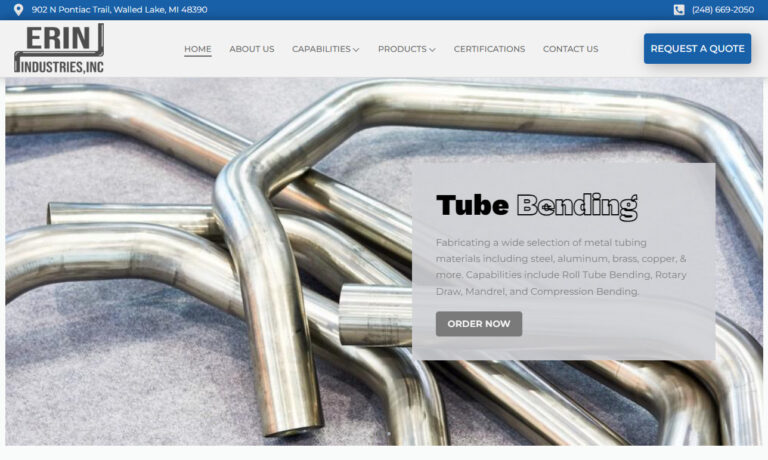
At Erin Industries, Inc., we take great pride in our expertise and capabilities in the field of tube fabrication. With a commitment to precision, reliability, and innovation, we continuously strive to elevate the standards of tube fabrication within the industry. Erin Industries, Inc. is your trusted partner for all your tube fabrication needs, delivering products and services that meet and...
Chardon Metal Products leads the industry in CNC precision machining, tube bending, fabrication, screw machine products, and assembly services. We're proud to offer a diversified portfolio of manufacturing processes to meet customer's needs. Our diversity and problem solving expertise have allowed us to grow and strengthen our position in the marketplace over the past seven decades. Contact us...
At Hafendorfer Machine, Inc., we specialize in tube fabrication services that support precision manufacturing across demanding industrial applications. We work with a wide range of metals and tube sizes, applying tightly controlled processes to ensure dimensional accuracy, structural integrity, and repeatable quality.
At Hafendorfer Machine, Inc., we specialize in tube fabrication services that support precision manufacturing across demanding industrial applications. We work with a wide range of metals and tube sizes, applying tightly controlled processes to ensure dimensional accuracy, structural integrity, and repeatable quality.




More Tube Flaring Manufacturers
Many industries—including automotive manufacturing, aerospace, HVAC, plumbing, hydraulics, and industrial processing—rely on the efficient and reliable transport of liquids and gases through piping and tube systems. Pipe and tube connections play a critical role in these applications, and ensuring leak-free, robust connections is essential for system integrity, safety, and long-term performance. One of the most effective methods for achieving this is through tube flaring.
 Tube Flaring - STAM, Inc.
What is Tube Flaring?
Tube flaring is a metalworking process used to form the end of a tube into a funnel or conical shape. This precisely engineered flare enables the tube to mate securely with a corresponding fitting, such as a flare fitting or compression fitting. The resulting connection ensures a tight, leak-free seal capable of withstanding significant pressure, vibration, and temperature fluctuations. Tube flaring is especially vital in applications where the containment of fluids or gases is mission-critical, such as hydraulic brake lines, refrigeration systems, fuel lines, and high-pressure pneumatic systems.
How Does Tube Flaring Work?
Flaring creates a funnel shape at the end of the tube, which is designed to exactly match the dimensions of the fitting or component it will be joined to. This precision ensures a seamless, secure fit that minimizes the risk of leaks or system failure. During installation, the tube’s flared end is positioned against a cone-shaped seat within the fitting, and a flare nut is used to draw the connection tight. As the nut is tightened, it compresses the flare against the fitting surface, forming a robust metal-to-metal seal. This eliminates the need for additional gaskets or sealing materials, simplifying the assembly process and enhancing reliability.
- Single Flaring: The tube end is flared outward in a single step, creating a basic cone shape. This method is often sufficient for low- to moderate-pressure applications.
- Double Lap Flaring: For tubes subjected to higher stress, vibration, or corrosive environments, a double lap flare is recommended. This technique involves folding the tube end over itself before flaring, resulting in a thicker, reinforced lip. The increased strength helps prevent cracking, splitting, or deformation, ensuring a longer service life even in demanding conditions.
Flaring vs. Swaging: What’s the Difference?
When evaluating tube joining techniques, it’s common to compare flaring with tube swaging. Both methods are used to join two previously unattached tubes or components, but they differ in execution and application:
- Flaring: Expands the tube end outward to form a cone that fits over a fitting’s cone-shaped seat. Used primarily for high-pressure, high-integrity connections.
- Swaging: Reduces or forms the tube end inward to fit inside another tube or fitting. Swaged joints are often used for joining tubes of different diameters or for applications where external sealing is required.
Both processes enable the secure transfer of liquids and gases through the system, but the choice between flaring and swaging depends on pressure requirements, material compatibility, and the specific engineering standards of the application.
Tube Flaring Tools, Equipment, and Angles
Proper tube flaring requires the right tools and careful attention to detail. A standard flaring tool kit consists of several key components designed to handle various tube diameters and wall thicknesses.
- Flaring Bar or Die Block: Contains precision-machined holes for different tube sizes, ensuring accurate alignment and secure clamping during the flaring process.
- Yoke and Cone Compressor: The yoke fits over the die block and holds the cone-shaped compressor, which is used to press into the tube end and create the flare under controlled pressure.
- T-Handle: Provides leverage for smoothly advancing the compressor screw, allowing the operator to form the flare with consistent force.
- Adapters for Double Flaring: Specialized inserts that help create the double lap flare by folding the tube end before final flaring.
The most common flare angle in North American industries is 45°, suitable for automotive, refrigeration, and general industrial applications. In contrast, a 37° flare angle is standard in aerospace and high-performance hydraulic systems, such as those using AN (Army-Navy) fittings. Selecting the correct flare angle is crucial for compatibility and leak prevention.
How to Use a Flaring Tool: Step-by-Step Guide
- Cut the Tube: Use a tube cutter to make a clean, square cut at the desired length, ensuring the end is free of burrs or distortions.
- Deburr the Edge: Smooth the inner and outer edges with a deburring tool to prevent cracks during flaring.
- Insert into the Die Block: Select the hole that matches your tube diameter and clamp the tube so the proper amount extends beyond the block for the size of flare you need.
- Position the Yoke and Cone: Mount the yoke over the die block, aligning the cone with the tube end.
- Form the Flare: Turn the T-handle to drive the cone into the tube, gradually applying pressure to shape the flare.
- Inspect the Flare: Check for symmetry, smoothness, and correct angle. The flare should be free of cracks, splits, or irregularities.
- For Double Lap Flare: Use the adapter to fold the tube end, then repeat the flaring process to finish the double lap flare.
Benefits of Tube Flaring in Industrial and Commercial Applications
Tube flaring offers numerous advantages for engineers, system designers, and maintenance professionals:
- Leak-Proof Connections: Metal-to-metal seals minimize the risk of leaks under high pressure or vibration.
- High Pressure Resistance: Ideal for hydraulic, pneumatic, and refrigeration systems that operate under demanding conditions.
- Ease of Assembly and Maintenance: Fittings can be installed or replaced without specialized tools, making field repairs fast and cost-effective.
- Vibration and Corrosion Resistance: Double lap flares provide added strength in harsh environments, reducing the risk of fatigue-related failures.
- Versatility: Compatible with a wide range of tube materials—including copper, aluminum, stainless steel, and brass—supporting diverse industries and applications.
- Elimination of Gaskets and Sealants: Reduces material costs and simplifies inventory management.
Common Tube Flaring Applications
Wondering where tube flaring is used? Here are some of the most common application areas:
- Automotive Brake Lines: Ensures safe, leak-free hydraulic connections in cars, trucks, and motorcycles.
- HVAC and Refrigeration: Facilitates reliable connections in air conditioning systems and refrigeration units, supporting efficient coolant flow.
- Aerospace Hydraulic Systems: Meets strict safety and performance standards for aircraft controls and fuel lines.
- Fuel and Oil Lines: Used in marine, industrial, and heavy equipment settings to prevent leaks and contamination.
- Industrial Process Piping: Maintains fluid integrity in chemical, pharmaceutical, and food processing plants.
Types of Flare Fittings and Compatible Tubing
Choosing the right flare fittings and tubing is essential for system compatibility and durability. Here are some key decision factors:
- Tubing Material: Copper tubing is popular for HVAC and refrigeration due to its corrosion resistance and workability. Stainless steel tubing is preferred for high-pressure, corrosive, or sanitary applications. Aluminum and brass tubes are used for lightweight or decorative systems.
- Flare Angle: Ensure fittings and flares match (typically 45° or 37°) to avoid leaks or mechanical failure.
- Fitting Type: Consider flare fittings, compression fittings, or swage fittings based on your system requirements and industry standards.
- Thread Compatibility: Match fitting threads to tube and system requirements (e.g., NPT, SAE, AN, or metric threads).
How to Select the Best Flaring Method for Your Project
Choosing the right flaring method depends on several factors related to your project’s technical requirements, operating environment, and regulatory standards. Ask yourself the following:
- What pressure and temperature will the system operate under?
- What materials are the tubes and fittings made from?
- Is the application subject to vibration, movement, or corrosive substances?
- Do industry standards (such as SAE J533 or ASTM specifications) require a specific flare type?
- Will the system require frequent assembly or disassembly for maintenance?
For high-pressure or safety-critical applications, double lap flaring is often the best choice. For general plumbing or HVAC, single flares may suffice. Consult with a tube fabricating specialist or review your industry’s guidelines for optimal results.
Tube Flaring Best Practices: Ensuring Quality and Reliability
Want to ensure leak-free, long-lasting tube connections? Follow these best practices for tube flaring:
- Always cut tubes with a sharp tube cutter to avoid deformation.
- Deburr all tube ends thoroughly to prevent cracks and leaks.
- Use a calibrated flaring tool appropriate for your tube material and size.
- Check flares for uniformity, symmetry, and absence of surface defects.
- Match flare angles and fitting types precisely to avoid compatibility issues.
- Inspect finished assemblies under pressure to verify system integrity.
- Follow all applicable safety guidelines and industry standards.
Proper training, high-quality tools, and rigorous inspection are key to successful tube flaring and system longevity.
Frequently Asked Questions About Tube Flaring
Looking for answers to common questions about tube flaring? Explore the topics below:
- What is the difference between single and double flaring?
Single flaring involves expanding the tube end once, suitable for lower-pressure systems. Double flaring folds the tube end over itself before flaring, providing extra strength and resistance to cracking, especially in high-pressure or vibration-prone applications. - Can I flare stainless steel or hard metal tubing?
Yes, but it requires specialized flaring tools designed for hard metals. Stainless steel, in particular, requires higher force and careful technique to prevent cracking. Always use the recommended tool and procedure for your tube material. - How do I prevent leaks in flared tube connections?
Ensure precise cutting, deburring, and correct flare angle. Use compatible fittings and avoid over-tightening, which can damage the flare or fitting seat. Regularly inspect connections for signs of wear or fatigue. - Are there alternatives to tube flaring?
Yes. Alternatives include compression fittings, push-to-connect fittings, and welding. Each has its own advantages and limitations regarding pressure rating, ease of installation, and long-term durability. - Where can I find tube flaring services or experts?
Many tube fabricating companies offer custom tube flaring services, including bending, cutting, and assembly. Look for providers with experience in your industry and capability to meet required standards.
Contact Us for Tube Flaring Solutions
Ready to improve your system’s reliability with professional tube flaring? Contact our team for expert advice, custom fabrication, or to request a quote on tube flaring services, tools, and fittings. Our knowledgeable staff can help you select the right materials, methods, and components for any industry or application.
Explore More Tube Fabrication and Pipe Connection Resources
Whether you’re building high-performance hydraulic circuits, installing HVAC systems, or seeking reliable plumbing connections, tube flaring remains a proven, cost-effective method for joining pipes and tubes. By understanding the process, benefits, and best practices, you’ll ensure safe, efficient, and durable fluid and gas transport in any industrial or commercial setting.
 Broaching
 CNC Machining
 Expanded Metals
 Laser Cutting
 Metal Etching
 Metal Fabrication
 Perforated Metals
 Screw Machine Products
 Metal Stampings
 Sheet Metal Fabrication
 Tube Fabrication
 Water Jet Cutting
 Castings & Forgings
 Bulk Material Handling
 Electrical & Electronic Components
 Flow Instrumentation
 Hardware
 Material Handling Equipment
 Metal Cutting Services
 Metal Forming Services
 Metal Suppliers
 Motion Control Products
 Plant & Facility Equipment
 Plant & Facility Supplies
 Plastic Molding Processes
 Pumps & Valves
 Recycling Equipment
 Rubber Products & Services